
Part I
How Martial Law Became “Insurrection” Overnight in South Korea
On December 3, 2024, South Korea awoke to a political vocabulary that had suddenly collapsed into a single word. Martial law. Within hours, the declaration was no longer discussed as a constitutional emergency measure, but as something far more grave: an insurrection.
The shift was swift and decisive. Prosecutors framed their investigation around the assumption that the declaration itself constituted a criminal act. Opposition leaders echoed the formulation. Headlines followed suit. Martial law, once a constitutional mechanism reserved for extreme national emergencies, was rapidly rebranded as proof of an attempted overthrow of constitutional order.
Yet this transformation raises a fundamental question—one that has been largely bypassed in the political uproar: Does the declaration of martial law, by itself, constitute insurrection under criminal law?
This series does not seek to defend a president or condemn a political camp. Its purpose is narrower and more demanding. It asks what the law requires—no more, no less—before a constitutional act can be reclassified as a crime of the highest order.
From Emergency Power to Criminal Allegation
Martial law occupies a paradoxical place in democratic constitutional systems. It is both legal and dangerous, permitted but feared. In South Korea, its historical associations—particularly with authoritarian rule in the late 20th century—have left a deep imprint on public memory. That history has shaped instinctive reactions to any mention of the term.
But constitutional law does not operate on instinct. It operates on structure, authority, and limits.
Under Article 77 of the South Korean Constitution, the president is explicitly empowered to declare martial law in times of war, armed conflict, or comparable national emergencies threatening public order. The provision is not ambiguous. Nor is it an accidental remnant of a bygone era. It is a deliberate constitutional design, balanced by parliamentary oversight and the power of the National Assembly to demand immediate termination.
In other words, martial law is not an extralegal act. It is an authorized constitutional power, constrained but legitimate.
The controversy, therefore, does not begin with the existence of this power. It begins with its exercise.
The Collapse of Legal Distinctions
In the days following the declaration, legal distinctions began to blur. Public discourse increasingly treated two separate questions as one:
-
Was the declaration of martial law justified under constitutional standards?
-
Did the declaration itself amount to the crime of insurrection?
These questions are not interchangeable. Yet in political debate, they were fused into a single moral and legal judgment.
Special prosecutors framed their inquiry around the idea that an unjustified or procedurally flawed declaration of martial law necessarily implied an intent to subvert constitutional order. Opposition leaders reinforced this logic, arguing that any misuse of such power constituted an attack on the Constitution itself.
This reasoning, however compelling politically, bypasses a critical legal threshold. Criminal law—especially in cases involving crimes against the state—demands more than impropriety, misjudgment, or even constitutional violation. It demands specific intent, defined conduct, and demonstrable structure.
Why Words Matter: “Insurrection” as a Legal Term
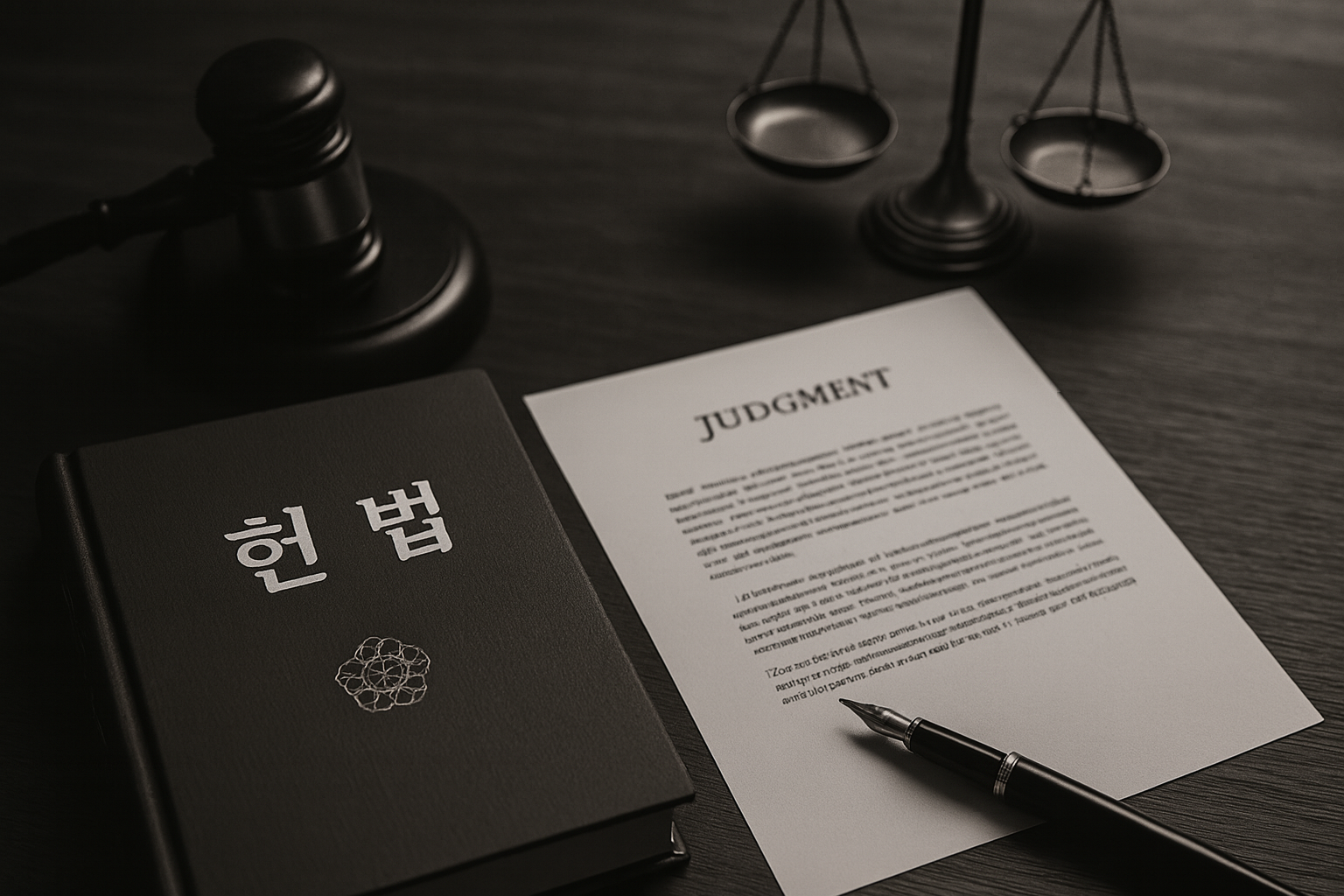
Under South Korean criminal law, insurrection is not a metaphor. It is a narrowly defined offense codified in Article 87 of the Criminal Act. The provision criminalizes collective acts carried out for the purpose of overthrowing constitutional order or seizing national territory, through organized and violent uprising.
This is not incidental language. It establishes insurrection as a purpose-driven crime, not a result-driven one. The mere existence of turmoil or illegality does not suffice. The prosecution must demonstrate intent to dismantle constitutional institutions and the use—or imminent use—of organized force to achieve that end.
Historically, South Korean courts have interpreted this standard with extreme caution. Past rulings emphasize that even severe constitutional violations do not automatically meet the threshold of insurrection unless accompanied by structured violence capable of paralyzing state functions.
This distinction is essential. Without it, constitutional governance becomes unstable. Emergency powers would be transformed into criminal liabilities not by legal criteria, but by political interpretation.
The Prosecutorial Narrative
The special prosecution’s approach reflects a broader shift in how constitutional crises are framed. Rather than examining whether the declaration of martial law satisfied criminal elements individually—intent, organization, violence—the investigation adopted a narrative logic: that the declaration itself evidenced an attempt to subvert democratic order.
This narrative resonates in a society sensitive to historical trauma. But resonance is not proof.
At no point in the initial public framing was there a clear articulation of how the constitutional act crossed the line into criminal insurrection. Instead, the argument relied on equivalence: that an illegitimate emergency measure must necessarily be criminal.
That assumption will be tested not in public opinion, but in courtrooms.
The Role of the Legislature—and Its Significance
One fact has remained largely uncontested: the National Assembly exercised its constitutional authority to demand the termination of martial law, and the declaration was lifted accordingly.
This matters. Not politically, but legally.
The functioning of constitutional safeguards undermines claims that state institutions were forcibly dismantled or rendered inoperative. Courts assessing insurrection claims have consistently treated the collapse or paralysis of constitutional order as a central element. Where institutions continue to function—even under strain—the criminal threshold becomes harder to meet.
This does not render the declaration immune from criticism or constitutional review. It does, however, complicate any assertion that the state itself was overthrown or seized.
A Question of Law, Not Allegiance
The speed with which “martial law” became synonymous with “insurrection” reveals less about the law than about political polarization. In moments of crisis, legal language often becomes a proxy for moral condemnation.
But criminal law resists shortcuts. It demands precision where politics prefers immediacy.
This series begins from a simple premise: a constitutional power cannot become a crime solely through political consensus. To argue otherwise is to allow constitutional meaning to fluctuate with electoral cycles and partisan majorities.
What Comes Next
Part II will examine the legal architecture of insurrection itself—how purpose, violence, and organization operate together under criminal law, and why courts have historically set such a high threshold for conviction.
Part III will return to the constitutional dimension, exploring why the misuse of emergency powers, even if grave, does not automatically translate into criminal liability without collapsing the distinction between constitutional failure and criminal rebellion.
The question, ultimately, is not whether martial law is dangerous. It always is.
The question is whether danger alone is enough to redefine law.
This series will argue that it is not.
MEDIA1 l Jungchan Lee, Publisher